

pt-cc
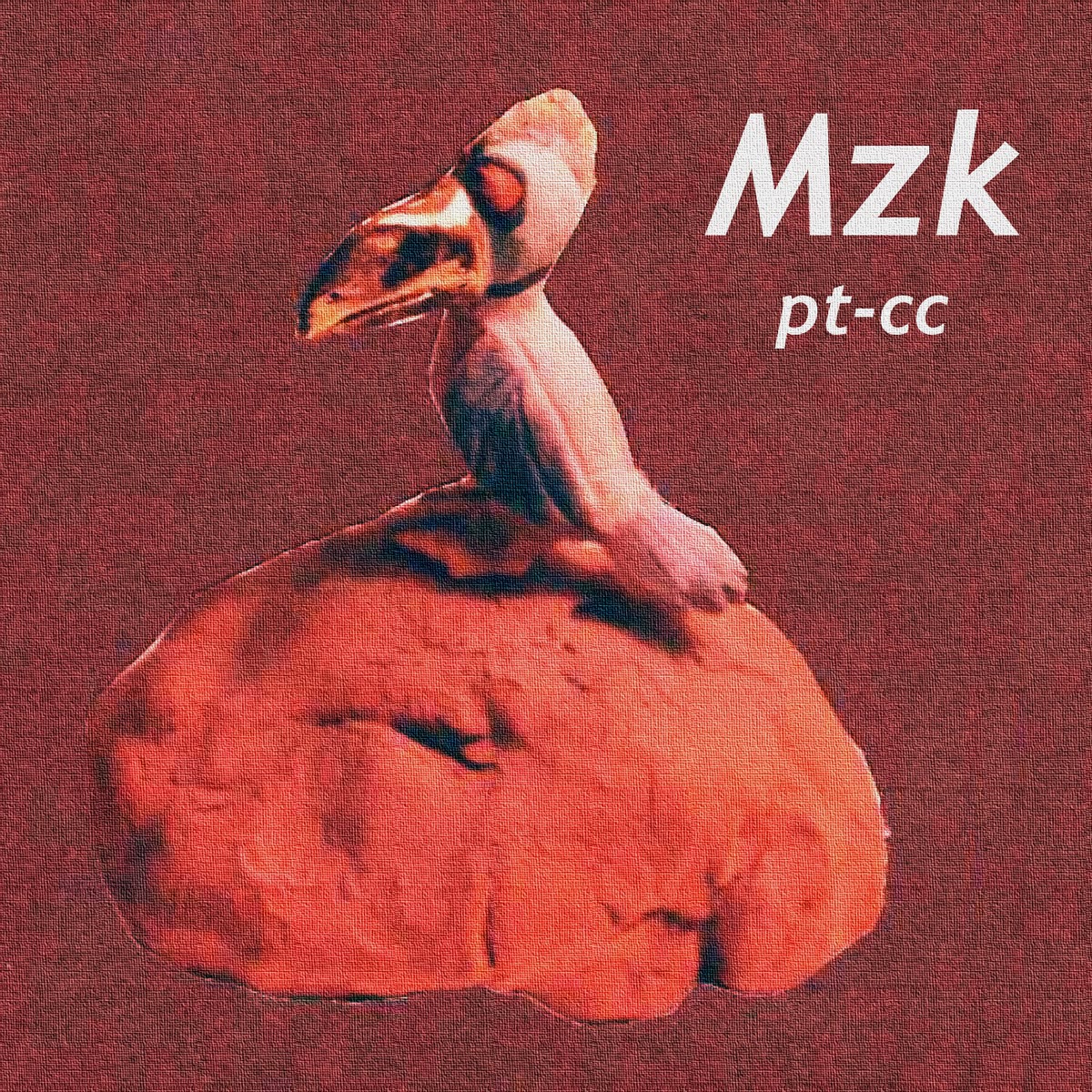
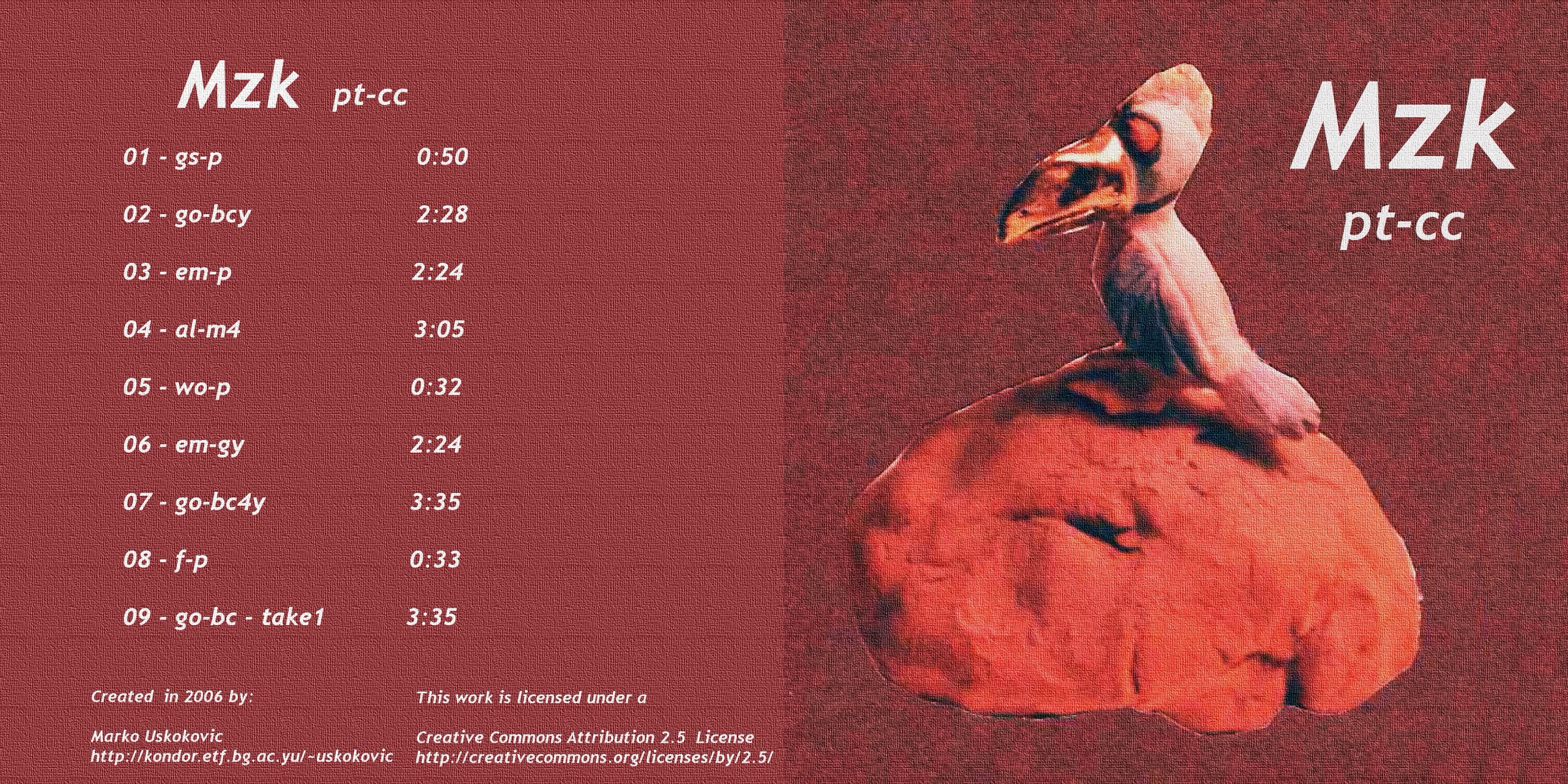
The earliest Mzk release: nine short instrumental sketches, published in November 2006. The track titles are the working codenames the files were saved under, and they were never replaced.
Recreated with AI as Ai-cc.
- Described by AI from the audioA brief electro-acoustic miniature built around prominent bird calls and airy, sustained tones. Rather than establishing a conventional groove, it rises from a quiet opening into a denser central swell, then thins out again, giving the piece the shape of a small field-recording vignette.
- Described by AI from the audioA slow, meditative electronic instrumental centered on a clear E-major sonority. Layered synthesizer and plucked, guitar-like tones enter through a long fade, settle into a restrained repeating pulse, and recede gradually, creating a calm, suspended atmosphere.
- Described by AI from the audioAn abstract ambient soundscape in which watery, wind-like noise and distant whistling tones are more prominent than a regular beat. The harmony leans toward A-flat minor, but texture is the real focus: soft environmental motion, isolated electronic color and an extended fade into near-silence.
- Described by AI from the audioA dark, steady electronic piece organized around an F-sharp-minor center and a slow pulse that can also be felt in double time. Low synthesizer tones support brass- and string-like layers, producing a compact, slightly ceremonial sound with only modest changes in intensity.
- Described by AI from the audioA short field-recording interlude dominated by close bird and insect calls. High, irregular chirps replace melody and percussion, while faint electronic traces sit behind them; the result is bright, restless and deliberately more like a captured outdoor moment than a conventional song.
- Described by AI from the audioAn E-minor electronic instrumental led by a high, wavering synthesizer voice with flute- or theremin-like color. A brisk underlying pulse gives the piece forward motion, but its sparse arrangement and long dissolving ending keep it closer to atmospheric sequencer music than to a full-band track.
- Described by AI from the audioA slowly unfolding E-centered synthesizer piece with a firm repeating pulse and prominent singing, theremin-like upper lines. It spends a long time emerging, broadens into layered keyboard and bowed-string colors, then withdraws through another extended fade, emphasizing gradual transformation over sharp sections.
- Described by AI from the audioA compact collage of bird calls, bright electronic tones and clipped percussion-like attacks. The sound is high-frequency, noisy and rhythmically unsettled, functioning as a vivid transitional miniature rather than a harmonically developed composition.
- Described by AI from the audioA spacious E-major keyboard instrumental with piano, electric-piano and organ-like colors. Its moderate pulse supports a patient repeating progression, while the long entrance and exit soften the structure into a continuous rise and fall; the mood is reflective, warm and faintly cinematic.
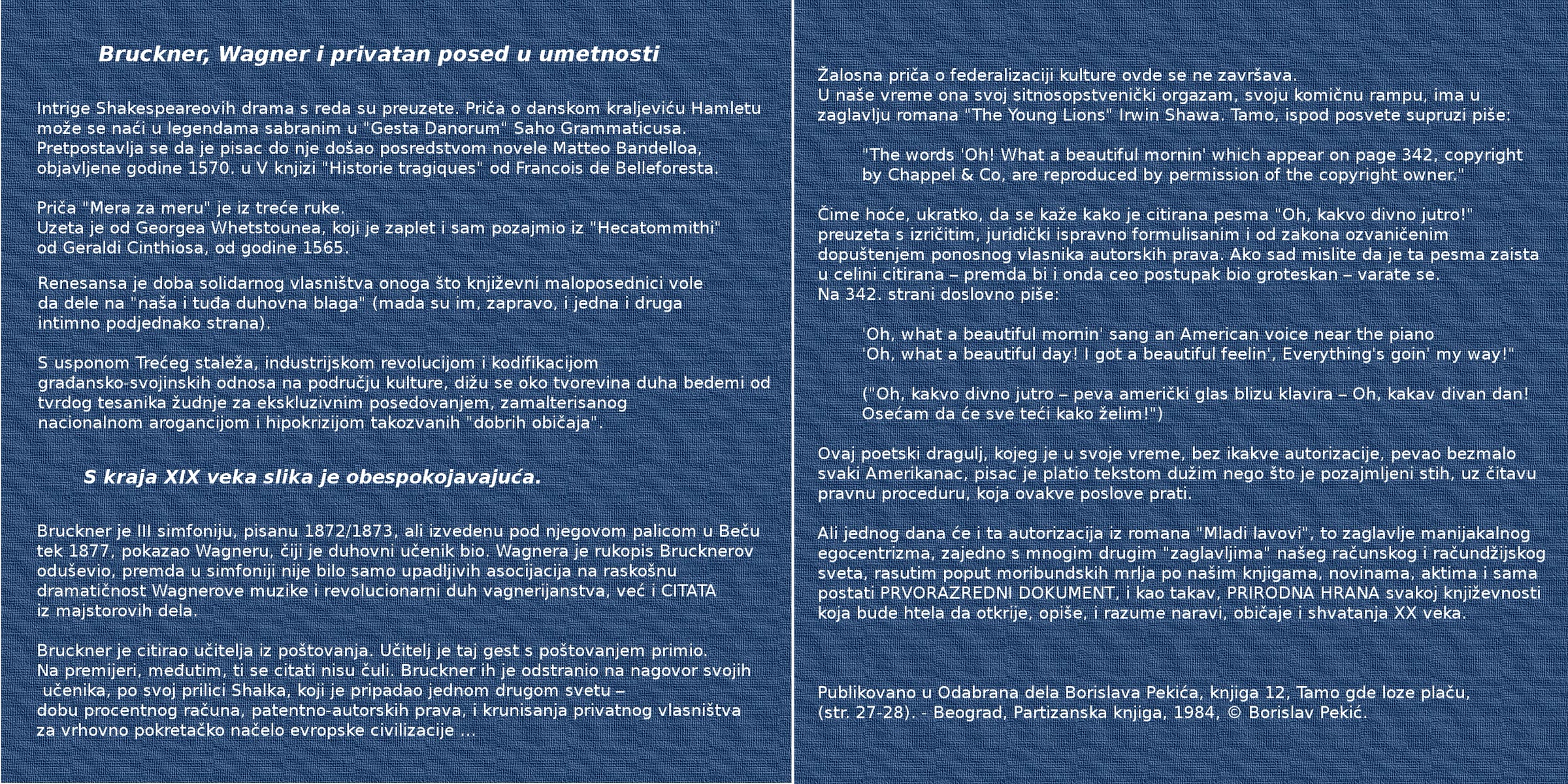
Bruckner, Wagner and private property in art
An excerpt from the inlay essay, translated from the Serbian:
Borislav Pekić, “Tamo gde loze plaču” (Odabrana dela, vol. 12, pp. 27–28), Partizanska knjiga, Belgrade, 1984. © Borislav Pekić. Quoted on the original 2006 inlay.Symphony No. 3, written in 1872/1873, but performed in Vienna in 1877, Bruckner presented to Wagner, whose spiritual disciple he was. Wagner was thrilled by Bruckner's work, even though that in the symphony there were not only striking associations to luxury drama of Wagner's music and the revolutionary spirit of the Wagner movement, but even QUOTES of the master's work.
Bruckner has quoted teacher out of respect. And the teacher has received that gesture respectfully.
However, at the premiere, those quotes were not heard. Bruckner removed them at the urging of his students, presumably Shalke, who belonged to another world - Age of percentage calculus, patent and copyright law, and the coronation of private property as the supreme animating principle of European civilization...